Classic
Around the world
How it looks and how to play
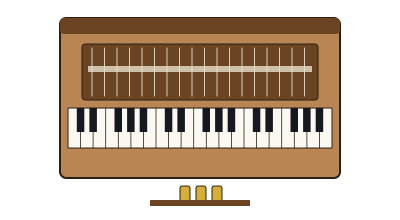
- Keys: 52 white and 36 black, 88 in all
- Inside: a felt hammer for each key strikes steel strings
- Pedals: the right one lets the notes ring on
How to play
- Rest your fingers on the keys; the thumb is finger 1.
- Press a key down and its hammer strikes the string.
- The left hand usually plays the low notes, the right hand the tune; hold the right pedal to let notes ring together.
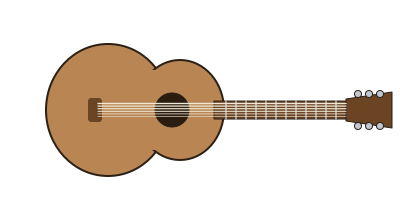
- Six strings, low E to high E
- Neck and frets
- Sound hole
- Bridge
- Tuning pegs
How to play
- Left-hand fingertips press a string just behind a fret to choose the note.
- The right hand plucks one string, or strums them all over the sound hole.
- Each fret closer to the body raises the note by a half step.
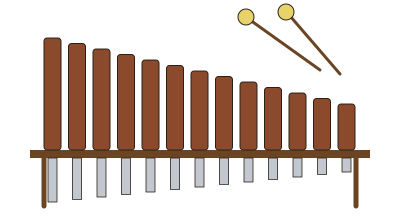
- Wooden bars, laid out like piano keys
- Resonator tubes under each bar make it louder
- Mallets with soft yarn heads
How to play
- Hold a mallet in each hand (players often hold two per hand).
- Strike the middle of a bar and lift away at once so it rings.
- Roll - fast strikes from both hands - to hold a long note.
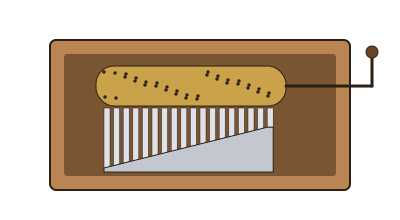
- Steel comb: each tooth is one note, shorter is higher
- A turning drum covered in pins
- Crank (or a wound spring)
How to play
- Turn the crank.
- Pins on the drum lift and release the comb's teeth one by one.
- Where the pins sit decides the tune, so each box plays its own song.
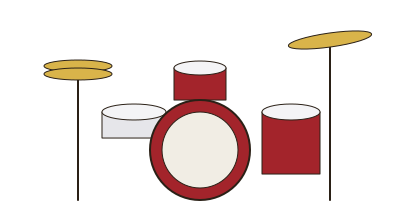
- Bass drum (kick)
- Snare drum
- Hi-hat: two cymbals on a stand
- Toms
- Crash cymbal
How to play
- The right foot presses the kick pedal on the beat.
- The right hand keeps time on the hi-hat; the snare usually lands on beats 2 and 4.
- The left foot opens and closes the hi-hat.
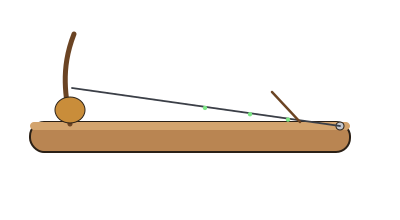
- Long wooden sound box
- One single string
- Flexible rod (cần đàn)
- Resonator (bầu), once a gourd
- Thin pick (que gảy)
How to play
- The right hand plucks with the pick while the edge of the palm touches the string lightly at a node (the green dots): this makes the pure harmonic notes.
- The left hand bends the rod, which tightens or loosens the string: the slide and the waver of the đàn bầu.
- To change note, move the touching point along the string.
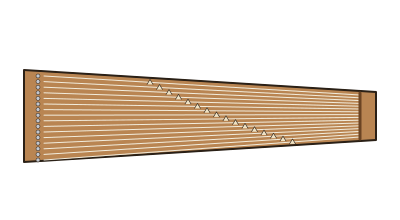
- Strings: 16 or 17 on the modern đàn tranh
- Movable bridges (ngựa đàn) set the tuning
- Tuning pegs
- The right hand plucks here, with fingerpicks
- The left hand presses here to bend the note
How to play
- Picks on the right thumb, index and middle fingers pluck to the right of the bridges.
- After a pluck the left hand presses the string left of its bridge: the note rises (nhấn) or wavers (rung).
- The strings are tuned to a five-note scale; pressing reaches the notes between.
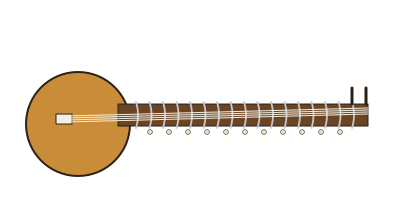
- Gourd resonator (tumba)
- Curved, movable frets
- Main playing strings
- Sympathetic strings under the frets, with their own small pegs
- Flat bridge (jawari): the buzz
How to play
- Played seated, the neck rising to the left; a wire pick (mizrab) on the right index finger plucks.
- Left fingers press the string on a fret and pull it sideways to bend the note (meend).
- The sympathetic strings are rarely plucked: they ring by themselves.
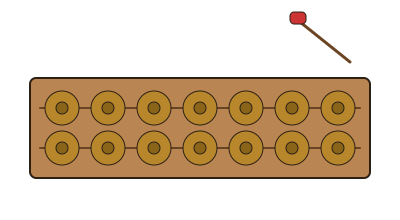
- Bronze kettle gongs, each one note
- Raised knob: strike here
- Wooden frame with cords
- Padded stick (tabuh)
How to play
- Strike the knob with the padded stick and let it ring; touch the gong to stop it.
- A gamelan is an ensemble from Java and Bali: players weave interlocking parts, and pairs tuned slightly apart make the shimmer.
- Real gamelan tunings (slendro, pelog) are not the piano's; ours is tuned to the piano scale so it can play the songs here.
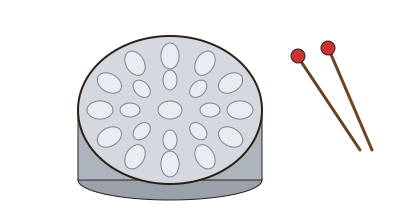
- Note areas hammered into the top, each one note
- Skirt: the cut-down side of an oil drum
- Sticks with rubber tips
How to play
- Strike a note area with the rubber tip and bounce straight off.
- To hold a long note, roll: fast strikes from both sticks.
- Invented in Trinidad and Tobago in the 20th century from oil drums.
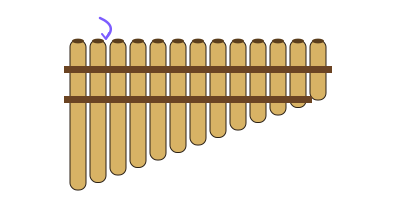
- Bamboo tubes closed at the bottom: longer is lower
- Binding that holds the rows together
- Blow here, across the top edge
How to play
- Rest the lower lip at the edge of a tube and blow a thin stream across the top, as over a bottle.
- Slide the pipes sideways to move between notes.
- In the Andes the siku is often shared by two players who alternate notes.
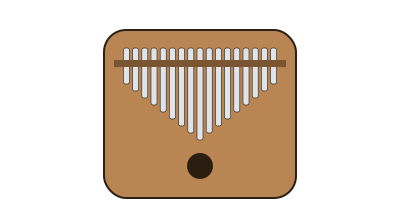
- Metal tines: the longest, in the middle, is the lowest
- Bridge bar that holds the tines
- Sound hole
- Thumbs pluck the tips of the tines
How to play
- Hold the kalimba in both hands and flick the tine tips with your thumbnails.
- Notes alternate left and right of the middle as they rise.
- It comes from the mbira family of southern Africa.
Play a song
Press a key to start.
Computer keys: A W S E D F T G Y H U J K O L P ; play the notes, Z and X move down or up an octave. Drag the strip above the keys to reach any part of the instrument. On drums, 1 to 8 hit the pads.
Every sound here is synthesized in our own studio from how the real instrument makes its sound, so it is close to the real thing, not a recording of it.
The songs are traditional or in the public domain.
PerfectGoodMissstreakaccuracyyour bestWell done - you played every note.Press the lit keyStopRecordnotes recorded.Nothing recorded.Cleared.Sound is off in this browser - check the volume or try another browser.
Piano: a felt hammer strikes steel strings; the high notes fade fast, the low ones ring.Guitar pluck: a plucked steel string.Marimba: wooden bars struck with soft mallets, from Central America.Music box: steel comb teeth plucked by pins on a turning drum.Drums: kick, snare, hats, clap, tom, rim and cowbell.Đàn bầu: one string and a flexible rod; the player bends the rod to slide the note. Listen for the slide up and the waver as each note rings.Đàn tranh: a long zither; the left hand presses the string after the pluck to lift the note.Sitar: a flat bridge makes the strings buzz, with drone strings ringing underneath.Gamelan: bronze gongs and kettles from Java and Bali; pairs tuned slightly apart shimmer.Steel pan: a hammered oil drum from Trinidad and Tobago, each note tuned with its octaves.Pan flute: bamboo pipes of the Andes, blown across the top - you hear the breath.Kalimba: metal tines plucked by the thumbs, from the mbira family of southern Africa.