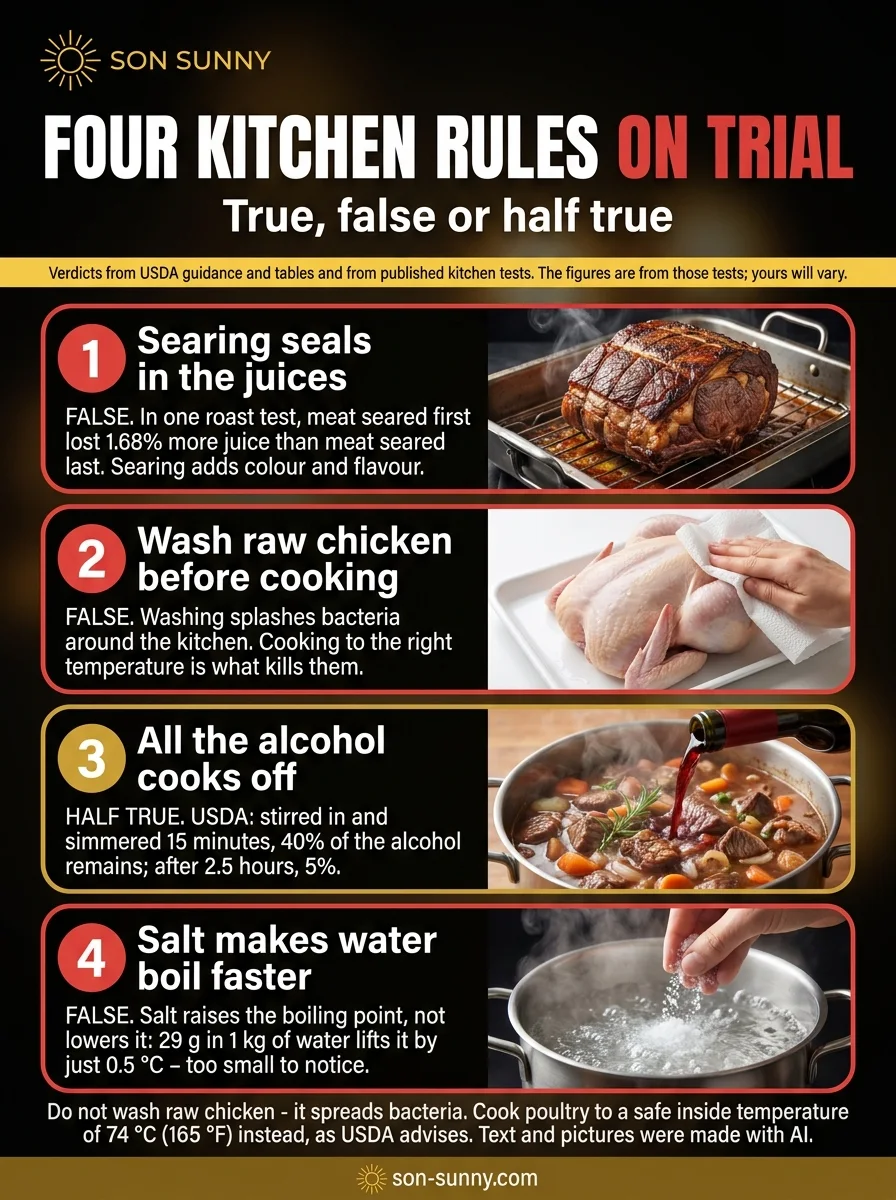
Verdicts from USDA guidance and tables and from published kitchen tests. The figures are from those tests; yours will vary.
Searing seals in the juices — FALSE. In one roast test, meat seared first lost 1.68% more juice than meat seared last. Searing adds colour and flavour.
Wash raw chicken before cooking — FALSE. Washing splashes bacteria around the kitchen. Cooking to the right temperature is what kills them.
All the alcohol cooks off — HALF TRUE. USDA: stirred in and simmered 15 minutes, 40% of the alcohol remains; after 2.5 hours, 5%.
Salt makes water boil faster — FALSE. Salt raises the boiling point, not lowers it: 29 g in 1 kg of water lifts it by just 0.5 °C - too small to notice.
Do not wash raw chicken - it spreads bacteria. Cook poultry to a safe inside temperature of 74 °C (165 °F) instead, as USDA advises. Text and pictures were made with AI.
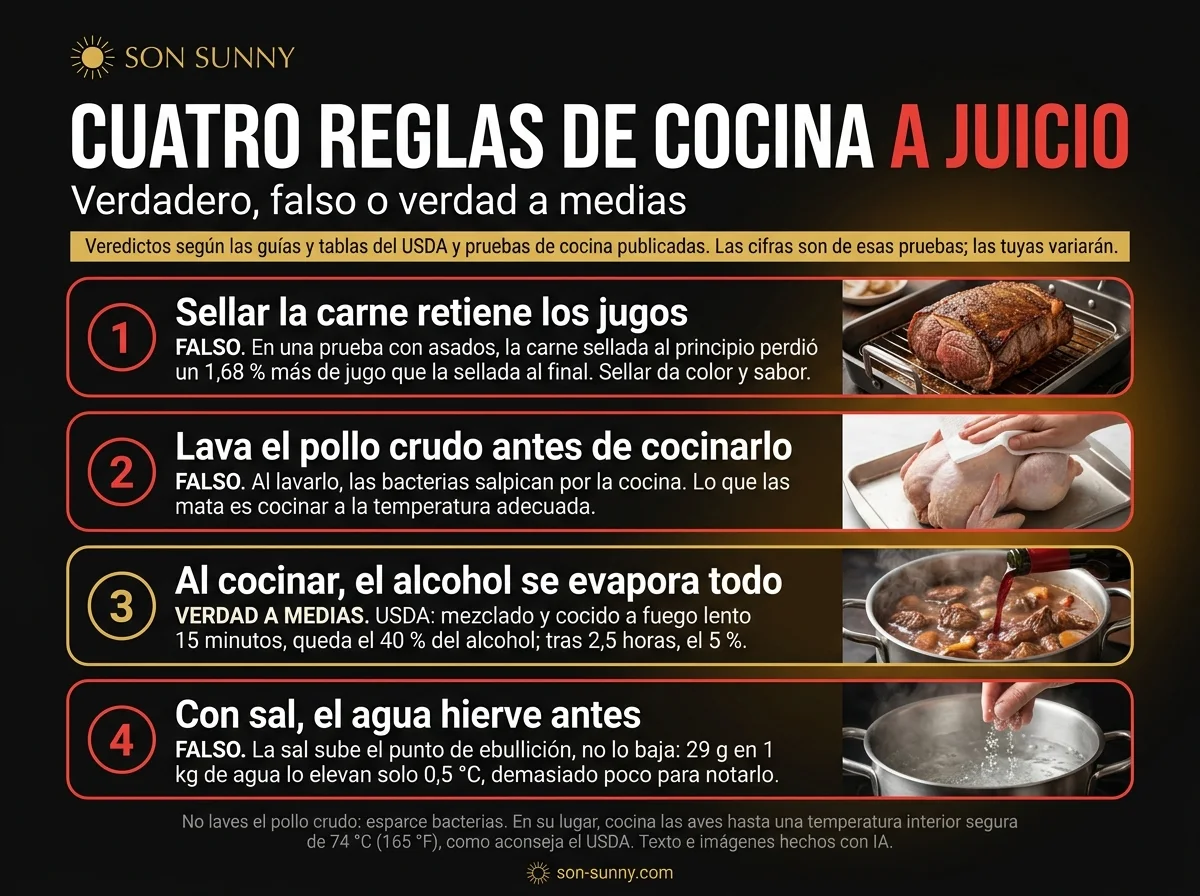
Cuatro reglas de cocina a juicio
Verdadero, falso o verdad a medias
Veredictos según las guías y tablas del USDA y pruebas de cocina publicadas. Las cifras son de esas pruebas; las tuyas variarán.
Sellar la carne retiene los jugos — FALSO. En una prueba con asados, la carne sellada al principio perdió un 1,68 % más de jugo que la sellada al final. Sellar da color y sabor.
Lava el pollo crudo antes de cocinarlo — FALSO. Al lavarlo, las bacterias salpican por la cocina. Lo que las mata es cocinar a la temperatura adecuada.
Al cocinar, el alcohol se evapora todo — VERDAD A MEDIAS. USDA: mezclado y cocido a fuego lento 15 minutos, queda el 40 % del alcohol; tras 2,5 horas, el 5 %.
Con sal, el agua hierve antes — FALSO. La sal sube el punto de ebullición, no lo baja: 29 g en 1 kg de agua lo elevan solo 0,5 °C, demasiado poco para notarlo.
No laves el pollo crudo: esparce bacterias. En su lugar, cocina las aves hasta una temperatura interior segura de 74 °C (165 °F), como aconseja el USDA. Texto e imágenes hechos con IA.
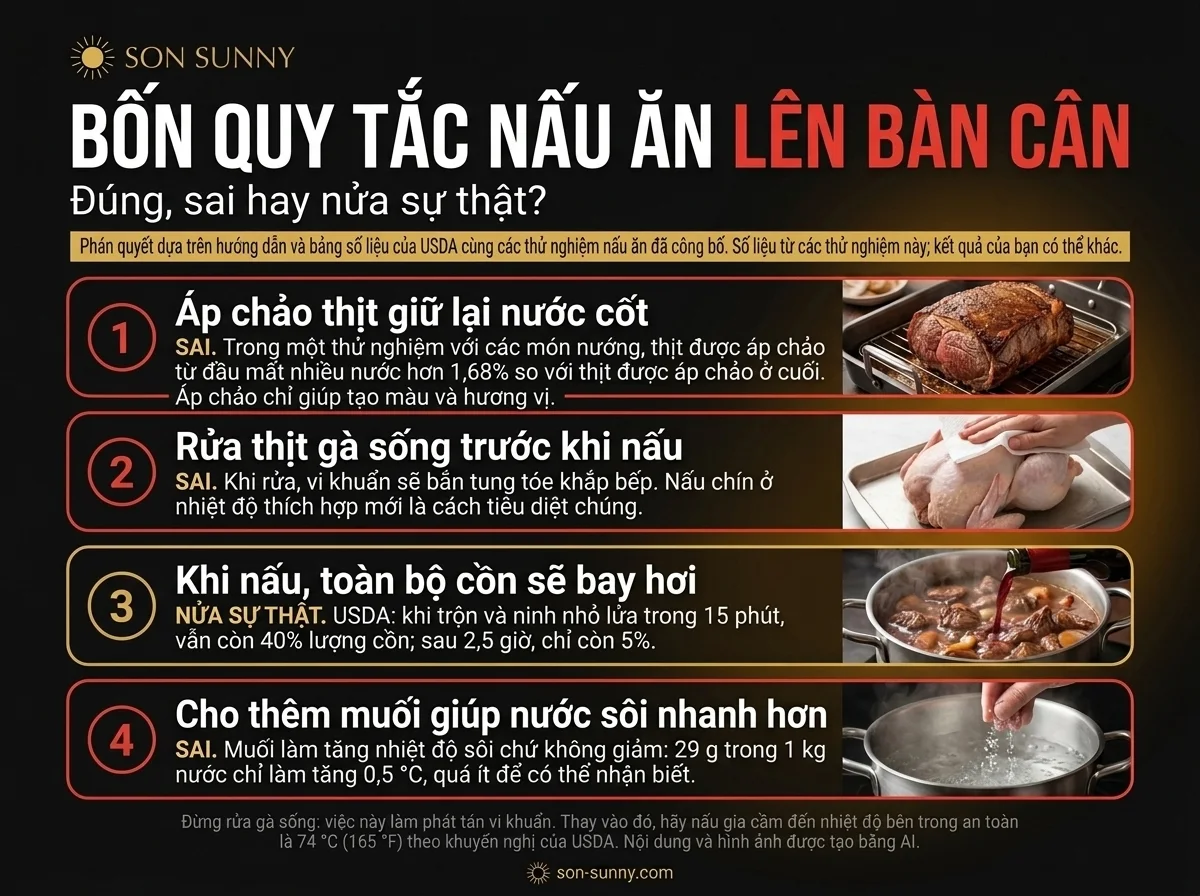
Kết luận dựa trên hướng dẫn và bảng số liệu của USDA cùng các thử nghiệm nấu ăn đã công bố. Con số là của các thử nghiệm đó; ở bếp bạn sẽ khác.
Áp chảo để khóa nước thịt — SAI. Trong một thử nghiệm thịt nướng lò, miếng áp chảo trước mất nhiều nước hơn miếng áp chảo sau 1,68%. Áp chảo tạo màu và hương vị.
Rửa gà sống trước khi nấu — SAI. Rửa làm vi khuẩn bắn ra khắp bếp. Nấu đủ nhiệt độ mới diệt được vi khuẩn.
Nấu lên là rượu bay hết — ĐÚNG MỘT NỬA. Theo USDA: khuấy vào món rồi ninh 15 phút, còn 40% lượng cồn; sau 2,5 giờ, còn 5%.
Cho muối thì nước sôi nhanh hơn — SAI. Muối làm tăng chứ không giảm điểm sôi: 29 g muối trong 1 kg nước chỉ nâng thêm 0,5 °C, quá nhỏ để nhận ra.
Đừng rửa gà sống - việc đó làm lây lan vi khuẩn. Thay vào đó, hãy nấu thịt gia cầm đến nhiệt độ bên trong an toàn là 74 °C (165 °F), theo khuyến cáo của USDA. Nội dung và hình ảnh được tạo bằng AI.